


Exhibitions
NINSEI Silver and Gold
2019.11.01(Fri) - 2019.12.08(Sun)
Celebrating museum renewal anniversary
Overview
MOA Museum of Art presents a special exhibition NINSEI - Silver and Gold, celebrating our three successful years following the renewal of the museum. Nonomura Ninsei opened his kiln in 1647, in front of the Ninnaji temple in Kyoto, and named it Omurogama. He made his name through excellent throwing skills, elegant designs in glazing and graceful forms, favored by many nobles and samurais of the time. Revisiting the historical development of his work styles at the Omurogama, the exhibition explores a diverse collection of Ninsei’s overglazed ceramics, focusing on the use of silver and gold colors. The overglazed tea leaf jars, inherited by the Kyōgoku clan, offer an interesting perspective on Ninsei’s designs as they are displayed next to the folding screens and craftworks as sources of inspiration.
◆Designs in paintings and kōgei craftworks seen through Ninsei’s eyes — Tea leaf jars of the Kyōgoku clan
The Kyōgoku clan of Marugame domain (present-day Kagawa prefecture) held a collection of overglazed tea leaf jars, water jars, and decorative nail head covers, all of which had been created around 1673 according to the clan’s official inventory. These objects are, for most past, registered national treasures and important cultural properties today. These items provide interesting reference points to consider Ninsei’s techniques in pottery as well as the designs elaborated in his ceramics. He takes ideas for the design on the tea leaf jars from such items as folding screens, lacquered craftworks and kimonos. Some of these items are also exhibited for visual comparison. The artist’s genius shows in the way in which he adds depth to two-dimensional designs.
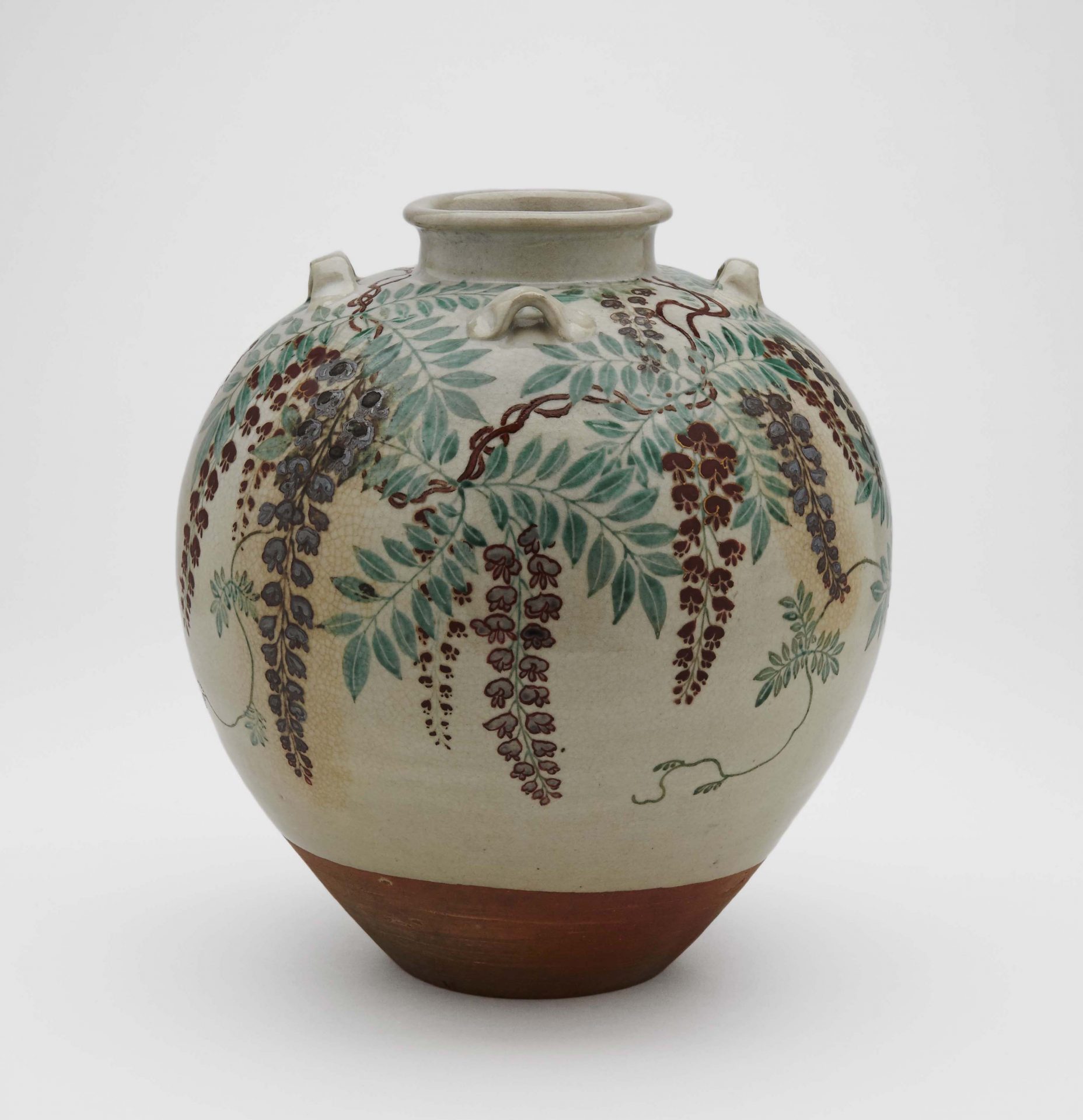
TEA-LEAF JAR
National Treasure
MOA MUSEUM OF ART
The ultimate masterpiece of Ninsei’s pottery, this jar depicts wisteria blooming in abundance, ingeniously distributed over the body of warm white base with a translucent glaze. The immaculate details are astounding — flowers and vines are delineated variously in red, purple, gold and silver, and every single leaf is drawn with capillaries. The overall shape is excellent, and the finely thrown body is almost equal in thickness. The motif comfortably matches the jar form. A branding of his name is made on the bottom in an oval design.
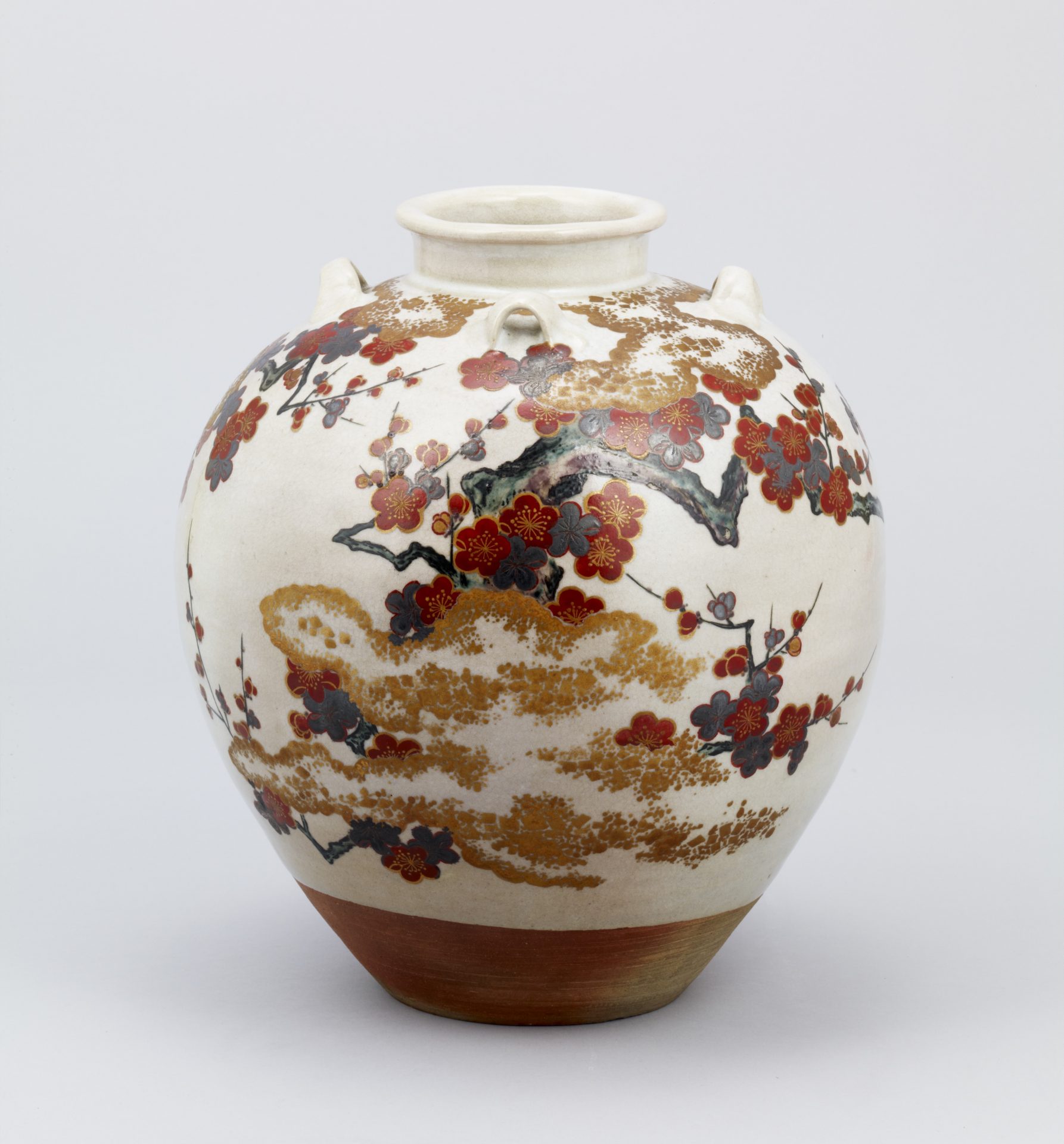 Image: TNM Image Archives
Overglazed tea leaf jar with moon and plum
Important Cultural Property
TOKYO NATIONAL MUSEUM
This beautifully rounded jar is believed to be bestowed to Taga Etchu, a chief retainer of the Kyōgoku clan, by the lord of the domain. A stylized cloud at the bottom issues a stout trunk of plum, which stretches up, bearing right, towards the moon in silver, arranged between two lugs at the top. The clouds in gold arranged around the top mingle with branches that cut across sideway. A large branding of his name is made on the bottom, towards the left.

Overglazed tea leaf jar with design of Mt. Yoshino
Important Cultural Property
FUKUOKA ART MUSEUM
Larger in size and more oblong than other jars in the Kyōgoku collection, this tea leaf jar depicts the mountains of Yoshino, famous for the splendor of cherry blossoms, in two different styles. On one side, mountains are formed by red and gold dots against green background, embellished with cherry flowers, all delineated in gold. The other image of Yoshino is composed of mountains painted in gold, red, blue and green, sprinkled with flowers in gold and silver without outlines. The throwing is relatively robust and uneven in places. The bottom is marked with Ninsei’s name engraved with a knife, as opposed to branding.
 Seikado Bunko Art Museum Image Archive / DNPartcom
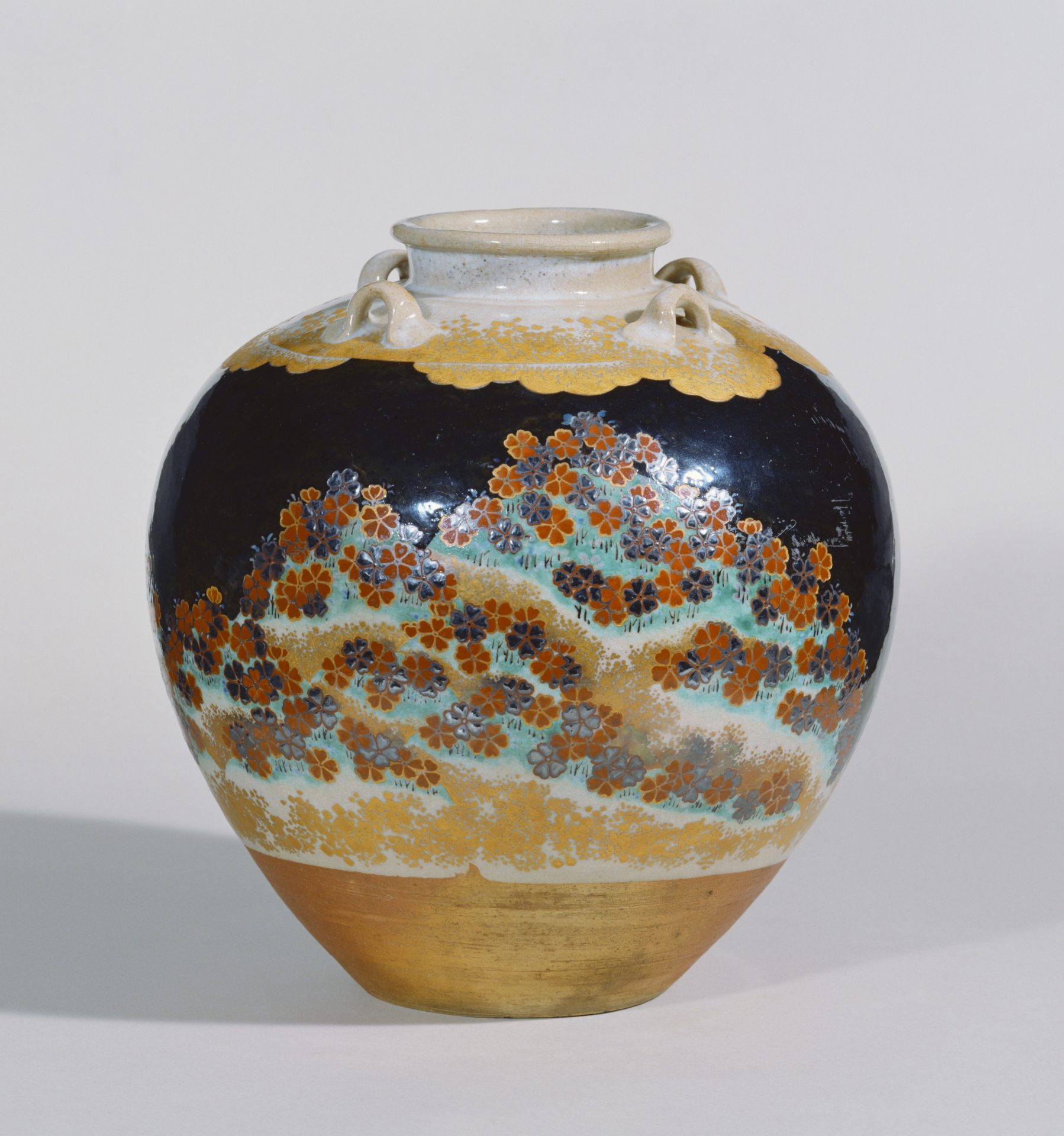
Overglazed tea leaf jar with design of Mt. Yoshino
Important Cultural Property
SEIKADO BUNKO ART MUSEUM
Wider than other specimens in the collection, this jar is finished in a translucent glaze, designed with mountains in green, embellished with cherry flowers. The sky above the mountains is smeared in Ninsei’s household name black pigment, accentuated by the stylized cloud in gold at the top. Cherry blossoms are depicted in two patterns, red outlined in gold and silver outlined in red. The unglazed band at the bottom is rather reddish compared to other jars. A large branding of his name is made in the center of the bottom flat.

Overglazed tea leaf jar with design of temple in mountains
Important Cultural Property
NEZU MUSEUM
The smallest in the Kyōgoku collection, this jar has an atypical shouldered form with only three lugs. The springtime scenery with a towered temple is depicted on a translucent glaze, with the mountains and spring mists painted in slip. This jar represents the most picturesque of all decorated jars by Ninsei, perhaps because of its shape, rendering a composition easier than ordinary jar-shape surfaces. A large branding of his name is marked on the bottom in an oval design.
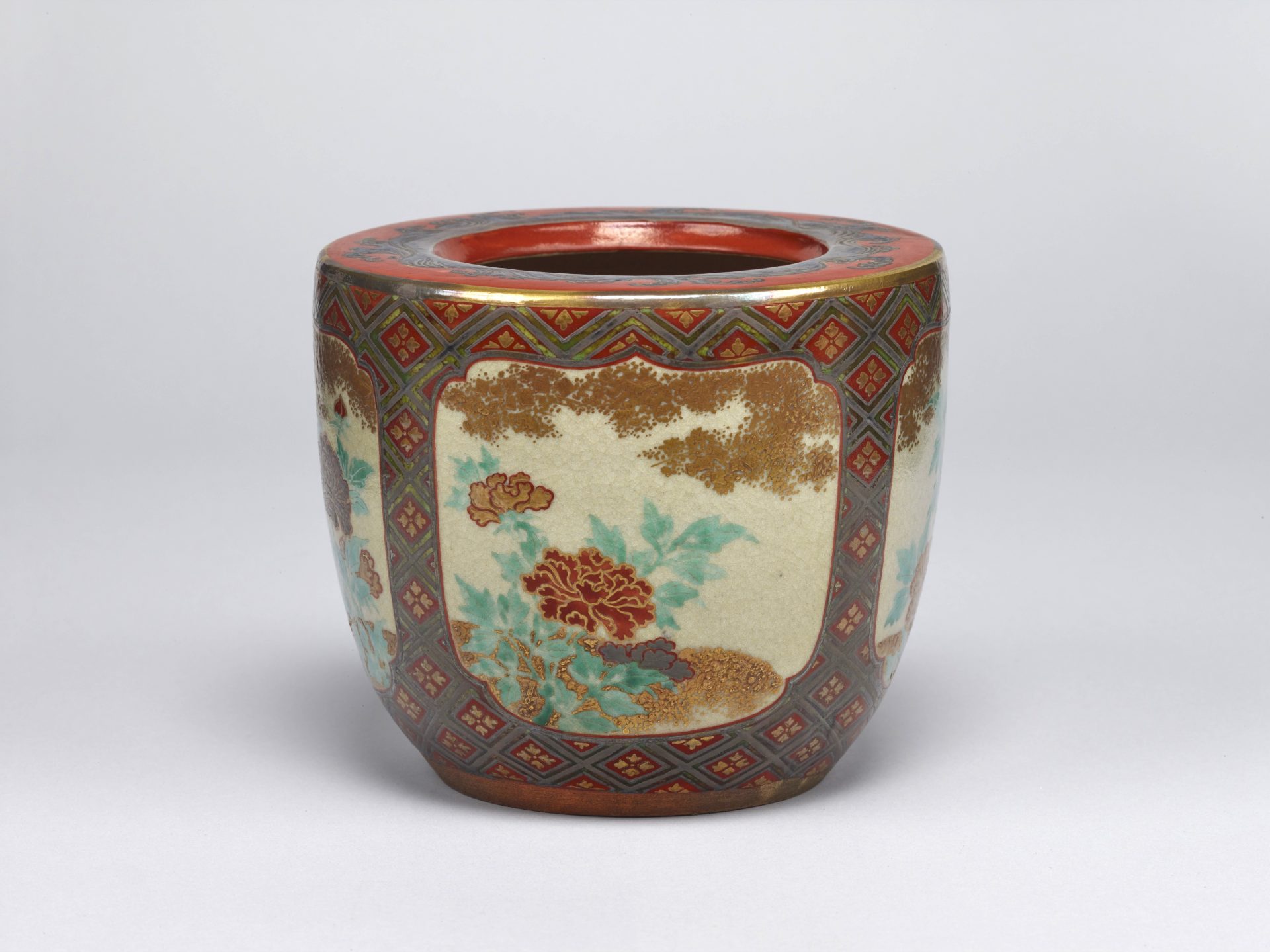 Image: TNM Image Archives
Overglazed water jar with design of peonies
Important Cultural Property
TOKYO NATIONAL MUSEUM
This is one of several water jars of this shape by Ninsei, cataloged as “Water jar in red glaze with peonies” in the Kyōgoku household inventory. The four “windows” are designed with peonies in different patterns, using gold, silver and red underglazes. The frames are decorated with diamond scroll in red, silver and green while the top of the jar is designed with rolling waves against the red backdrop. A large branding of “Ninsei” is inside the bottom concave.
◆Gold, silver and colored glaze - evolution
Ninsei is believed to have produced colored ceramics from early days of his Omurogama kiln. His early works only used glazes in blue, light blue, red and few other colors, but later his designs gradually became more elaborate. This section focuses on his works of overglazed utensils, including incense burners, tea bowls, flower vases and water jars, showcasing the artist’s typical colorful designs.
Overglazed incense burner designed with dharma cakra and double vajra
Important Cultural Property
FUJITA MUSEUM
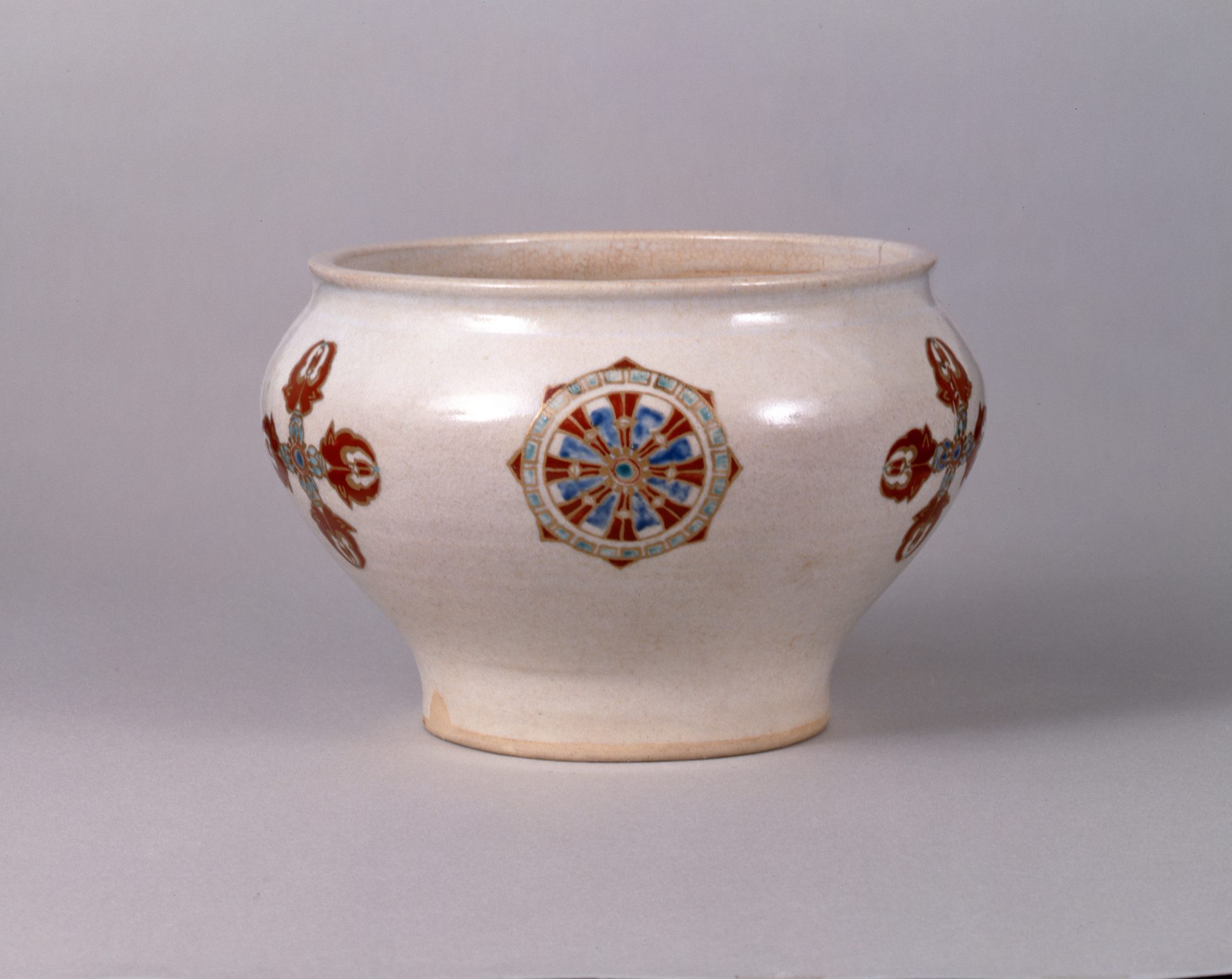
This incense burner is designed with dharma cakra and double vajra, arranged alternately around the body. The bottom is inscribed with the dedication that Ninsei created this as a donation, dated April 1657. From the date is suggested that Ninsei already mastered the overglazing technique by 1657. The description on the wooden container box states that the incense burner was donated to the An-yoji temple in Kyoto as Ninsei’s vow to become an excellent potter.
Overglazed vase with auspicious Buddhist design
Important Cultural Property
Ninnaji temple
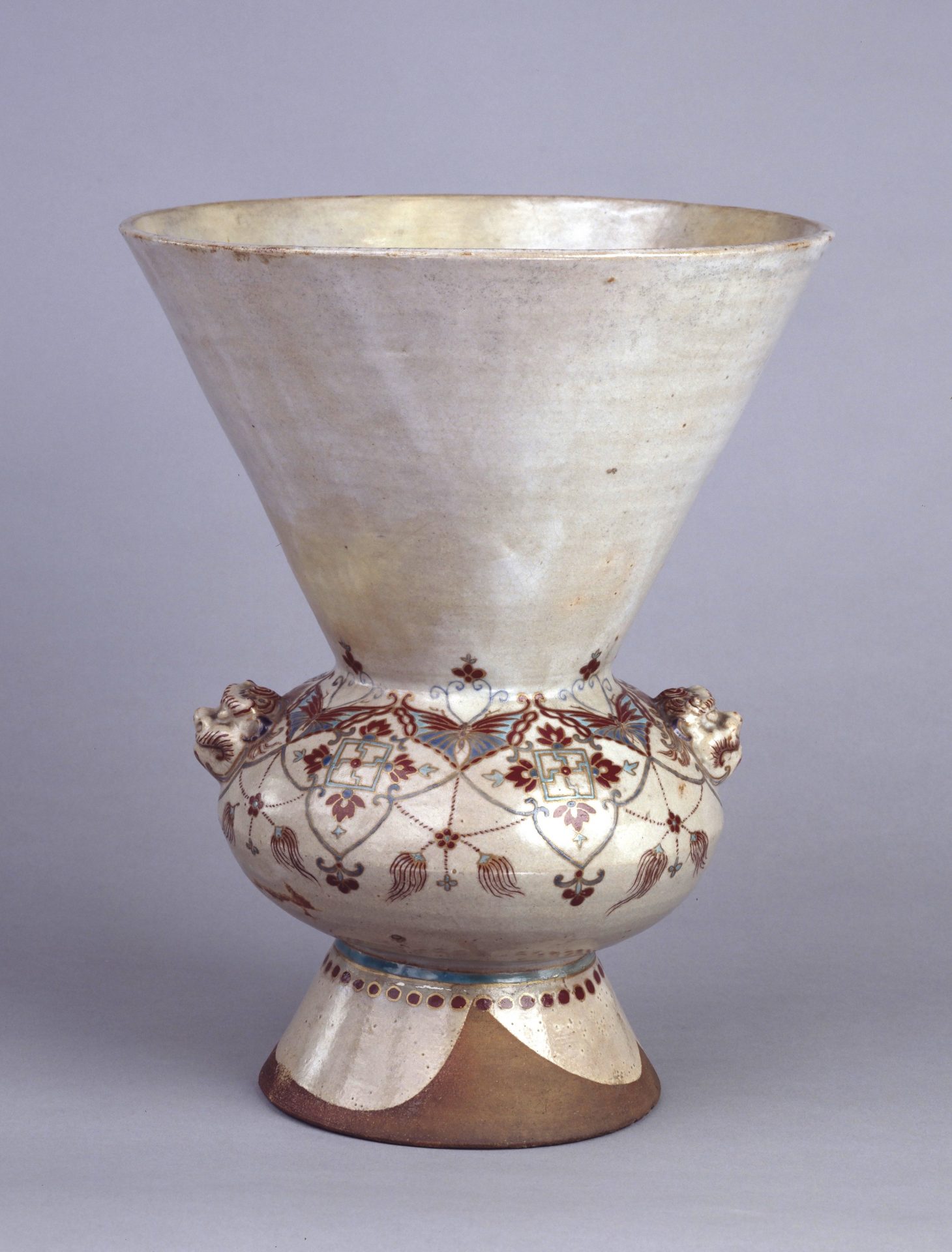
This vase takes a shape similar to an ancient bronze vase, with wide and tall opening, rounded body in the middle and tapered base. There are two lugs on the shoulders in the shape of a devil mask. The glaze is arranged on the base stand to a decorative effect while covering the upper body in cream-white color. The pattern is taken from the decorative hanging seen in Buddhist alters, containing the images of butterflies, swastikas and other Buddhist motifs. The provenance is the Ninnaji temple in Kyoto, which was near Ninsei’s Omurogama, and it is believed to be donated by the artist.
 Seikado Bunko Art Museum Image Archive / DNPartcom
Overglazed incense burner in the shape of a “giant triton”
Important Cultural Property
SEIKADO BUNKO ART MUSEUM
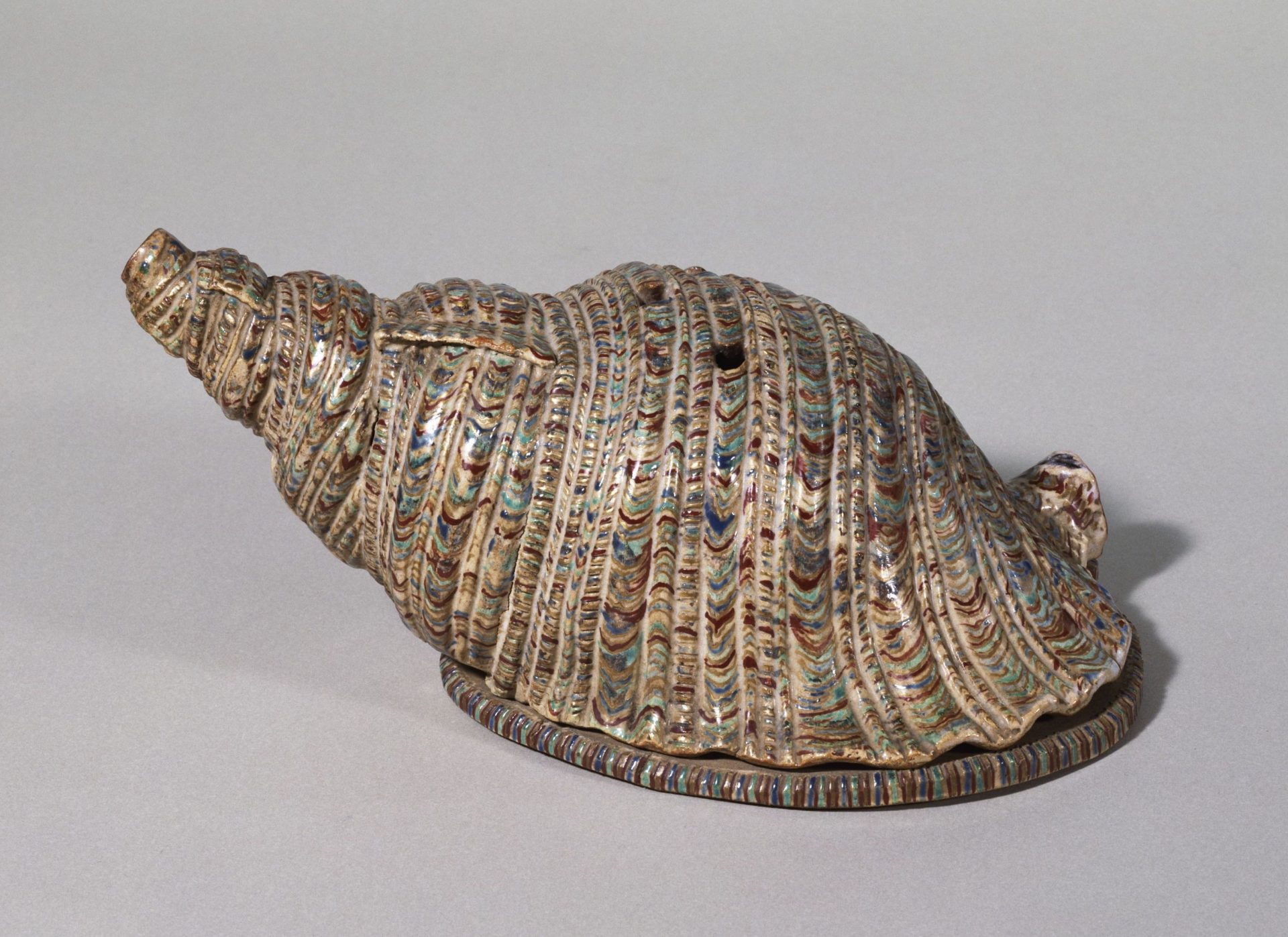
One of Ninsei’s best modelled ceramics, mocking a seashell “Triton’s trumpet,” which was used indeed as a trumpet in battle fields since olden times. The colorful patterns in the shell are eye-catching while the uneven distribution of grooves and spiral coil of the shell give a realistic impression. Three smoke outlets are pierced on the top part, aligned with the wavy patterns. Technically, this is a highly perfected piece of work. The base is glazed only on the rim, and Ninsei’s cocoon-shaped branding is applied in the center on the bottom of the base.
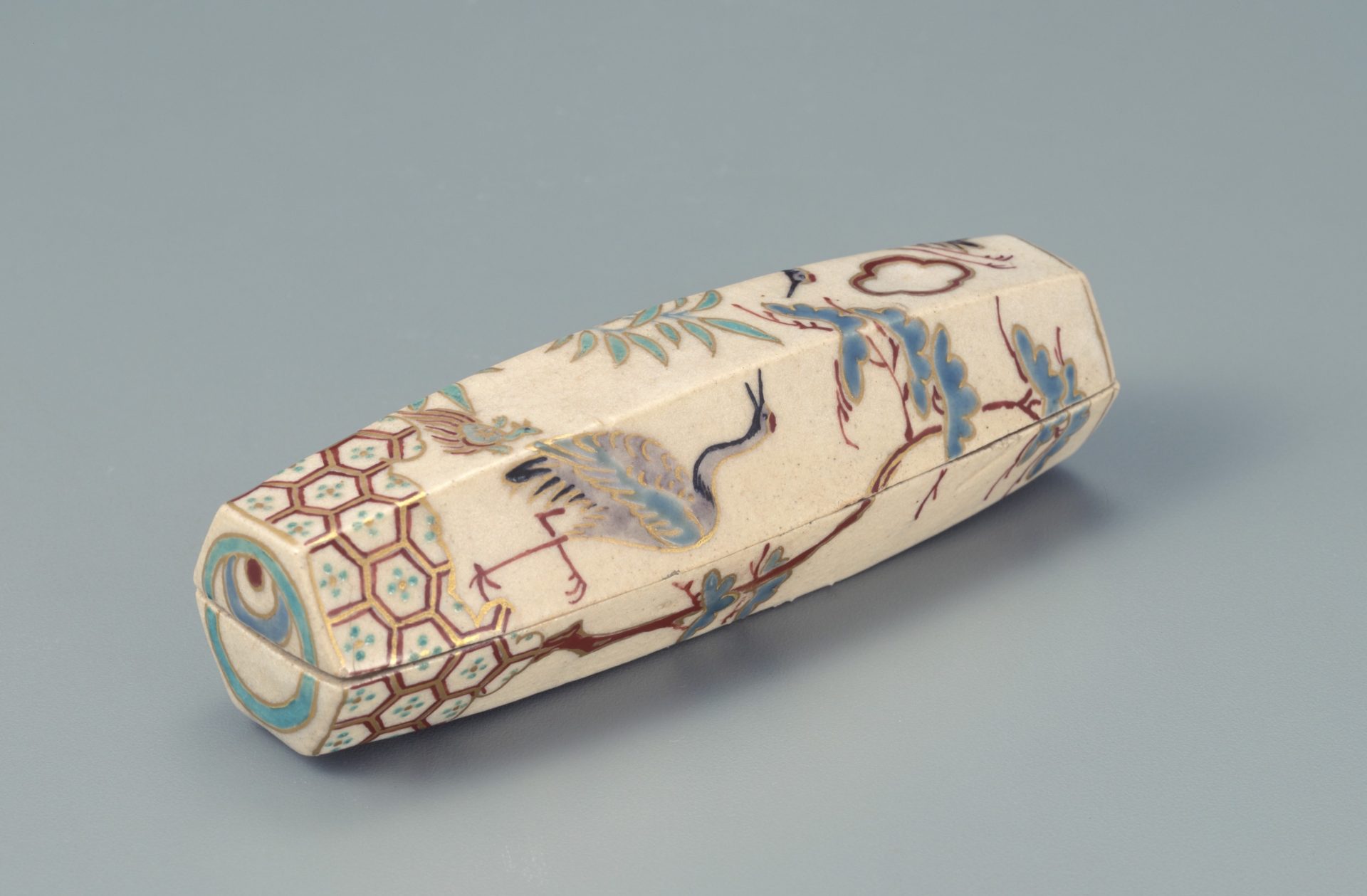
Overglazed incense container
NEZU MUSEUM
This incense burner takes a shape of a game tool like a golf club, of which only the head is represented. This game is called buri buri gitcho, and involved the clubs and a ball. The head part in a hexagonal block has an indent near one end, where a handle would normally be attached. On the base white background, auspicious motifs, such as pine, bamboo, crane and tortoise are arranged. The ends are decorated with a cintamani. The back of the lid and the bottom underneath are unglazed, with a small branding.
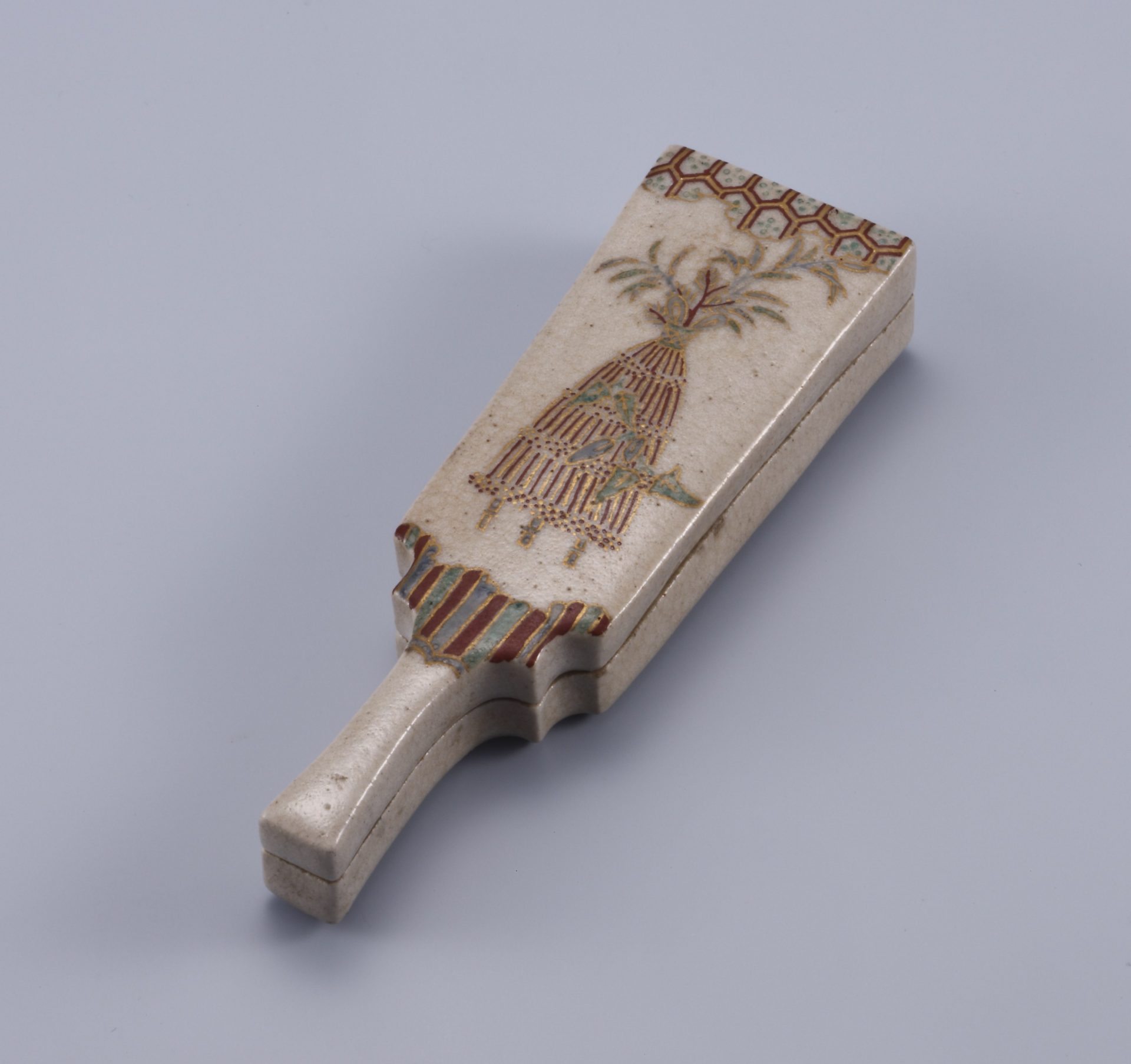
Overglazed racket-shaped incense container
NOMURA ART MUSEUM
The motif of this incense burner comes from an ancient rite of the court known as sagitcho, normally held on January 15. The rite involves three bamboos bound together in a rope, and burning a calligraphy written by the emperor in it. The intricate design, drawn in gold, red, green and blue inks against the white background, is executed with great care and finished in a translucent glaze. The bottom is unglazed, with a cocoon-shaped branding of Ninsei.

Overglazed incense container in the shape of a knot
YUKI MUSEUM OF ART
This incense burner is color-glazed only on the knot part, but the pattern applied to the knot is superbly executed, with the fine grid overlay with diamonds and dots in gold glaze. Inside, the lid and base are covered in green glaze with gold effecting a matrix, though it has worn off the base beyond recognition today. The knot part accommodates an incense for burning. The unglazed bottom shows dotted traces of firing and transparent glaze, and no branding is visible. Provenance of the famous Ikeda clan.

Overglazed incense container in Mandarin duck shape
THE MUSEUM YAMATO BUNKAKAN
Bird-shaped incense burners are one of Ninsei’s favorites. This Mandarin duck incense burner is delicately decorated with some special techniques, notably the rusty glazing on the beaks and feathers, apart from the blue, red and gold that cover the head and the wings. Inside, the entire area is finished in green glaze. The provenance is believed to be the Konoe clan. According to the biography of Konoe Iehiro (1667-1739), this incense burner was featured at a tea ceremony on November 20, 1732.
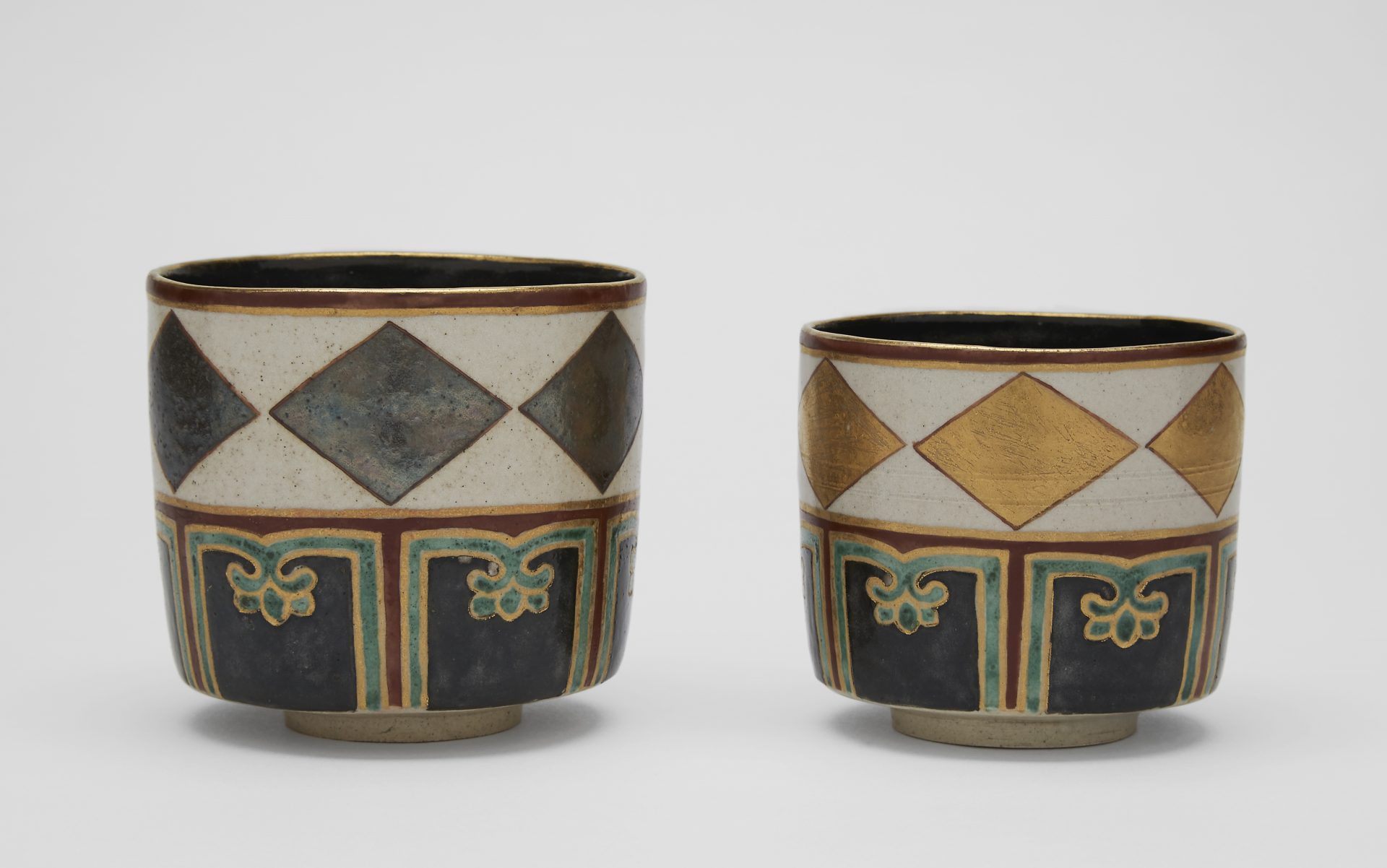
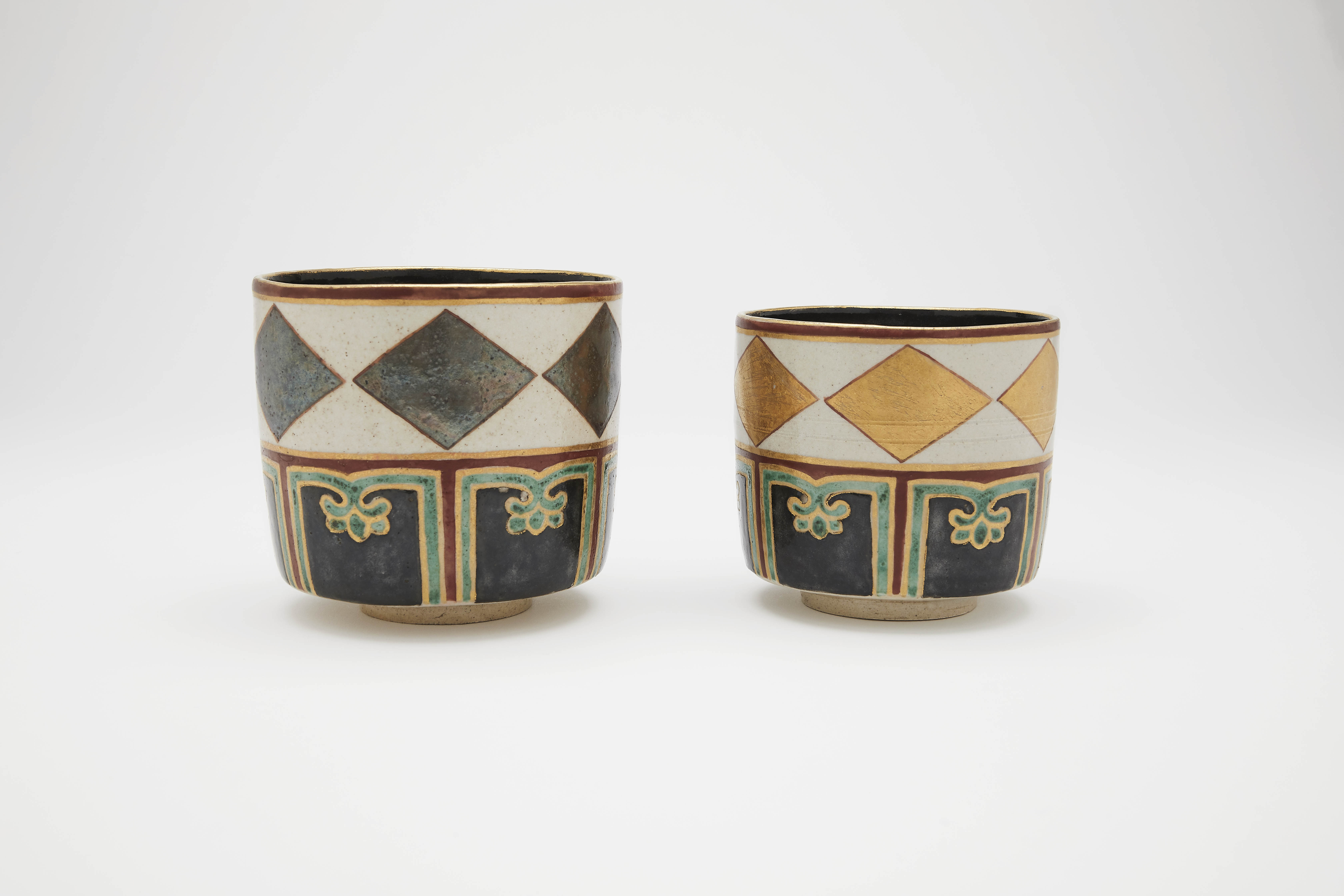
PAIR OF TEA BOWLS
Important Cultural Property
MOA MUSEUM OF ART
This set of bowls was created by Ninsei, believed to be commissioned by a tea master Kanamori Sowa to be offered to Tofuku-mon-in, the second wife of the Emperor Go-Mizunoo. The rim is decorated with gold and red bands, and Ninsei’s original black glaze covers the inside. On the outside, the white base accommodates lozenges, one in silver and the other in gold, outlined in red. The rather modern design defies the time. The base bears his branding inside.
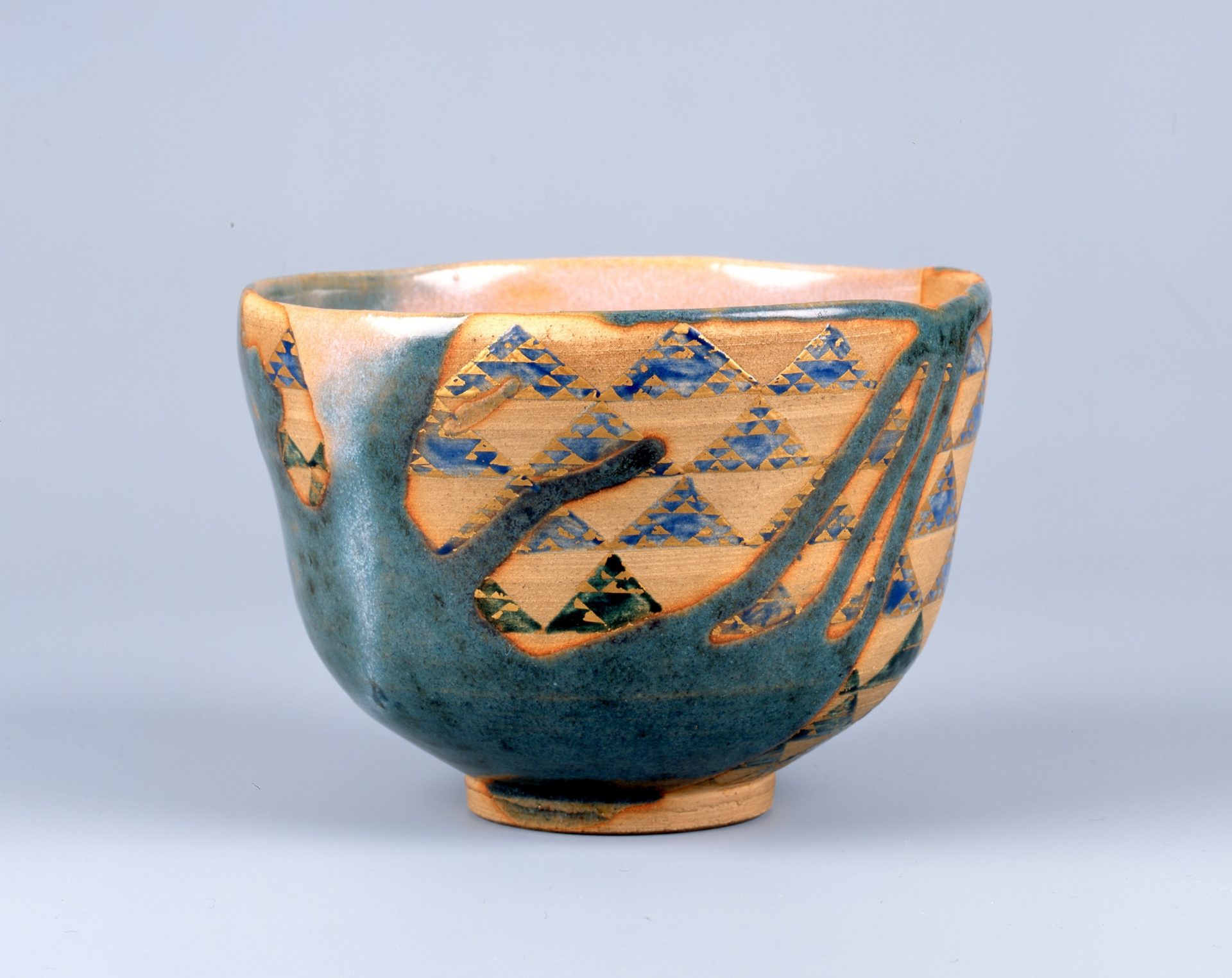
Overglazed tea bowl with design of triangle tiles and waves
Important Cultural Property
KITAMURA MUSEUM
Slightly squeezed body with a rounded rim that waves gently, the form favored by tea master Kanamori Sowa. This bowl is white-glazed on the inside, and on the outside eight rows of triangle tiles cover the entire surface, with a deliberate application of green glaze thrown from the bottom to the top to effect organic patterning. The colored triangles are also tiled inside in gold. The base is thinly formed, bearing his branding inside. The provenance of the Mitsui clan.
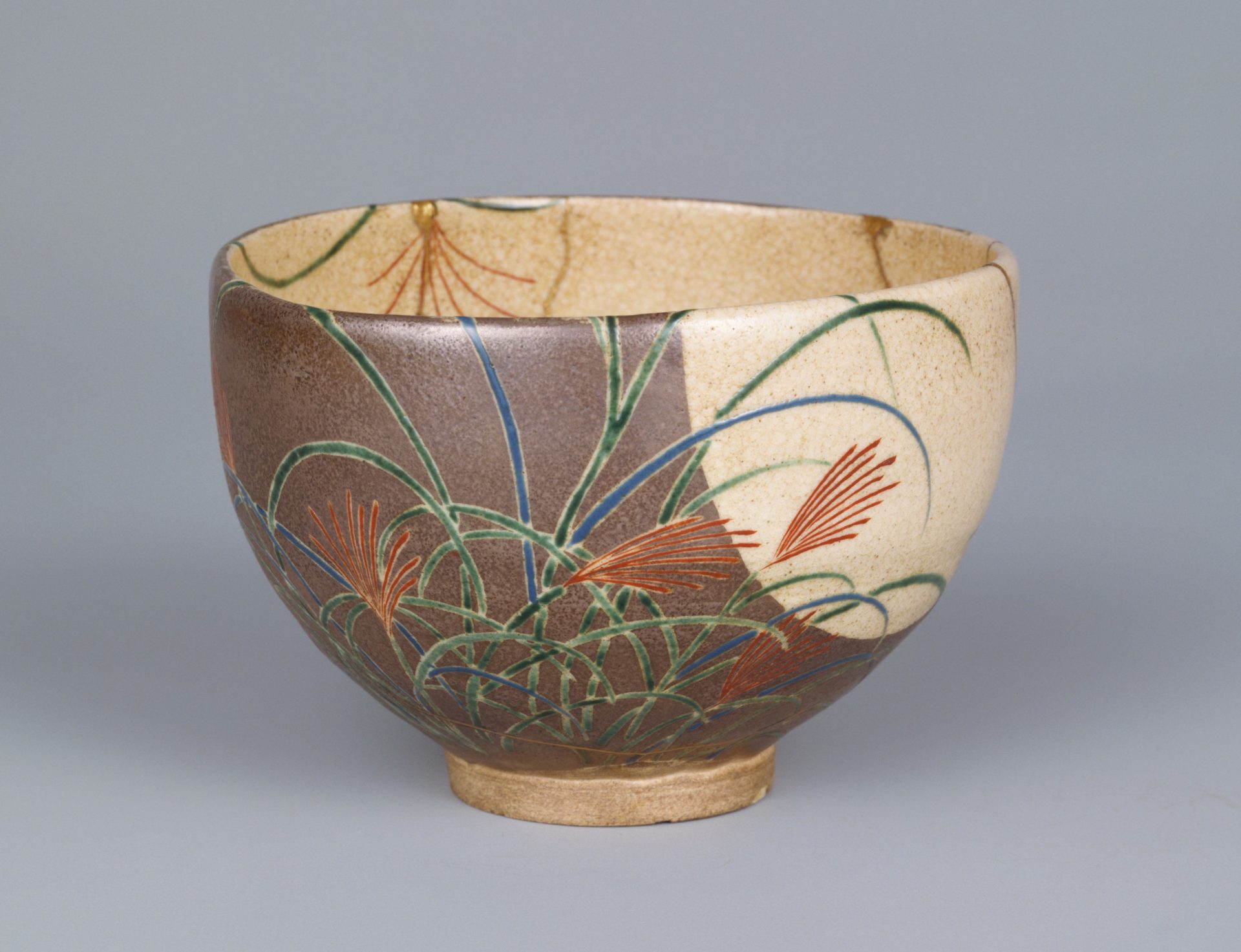
Overglazed tea bowl with ‘musashino’ design
Important Art Object
NEZU MUSEUM
Musashino refers to a scenic natural plane situated near Edo, often represented by autumnal grasses and foliage. This bowl bears the motif of silvergrass under the full moon in translucent glaze, and the backdrop is covered in silver, which was treated with sulfur for a matt effect to express the night sky. The silvergrass is drawn in blue, green and red pigments, extending partially into the internal wall. The base is thinly formed, bearing a small branding “Ninsei” inside.
◆Kanamori Sowa and Ninsei - taste in forms
Tea master Kanamori Sowa (1584-1657) was an influential figure throughout Ninsei’s career as a potter, most notably by encouraging him to open his own kiln near the Ninnaji temple in Kyoto. Part III of the exhibition focuses on the influence Kanamori had over Ninsei’s ceramics, particularly in the initial decade of the Omurogama. Recognized today as items “favored by Sowa” include copies of renowned Chinese tea caddies, copies of Korean tea bowls and utensils in white and rusty glazing. Ninsei’s innovative artistry is enjoyed in original dishes, water jars, tea bowls and other uniquely designed ceramics.

Square tea caddy with brown glaze
KOZU KOBUNKA MUSEUM
The tea caddy was thrown into a cylinder and molded to have four angles, finished in brown glaze with a streak of dark-pigment glaze. A grand chronicle of tea functions, Matsuya Hisashige Ta-kaiki (journal of tea functions which Matsuya attended as a guest), describes in the entry of March 25, 1648, that a tea caddy of similar descriptions was served, of the form favored by Sowa, and the firing named after the Ninnaji temple. The pattern on the bottom is a clockwise wire-cut, with a cocoon-shaped branding of Ninsei.
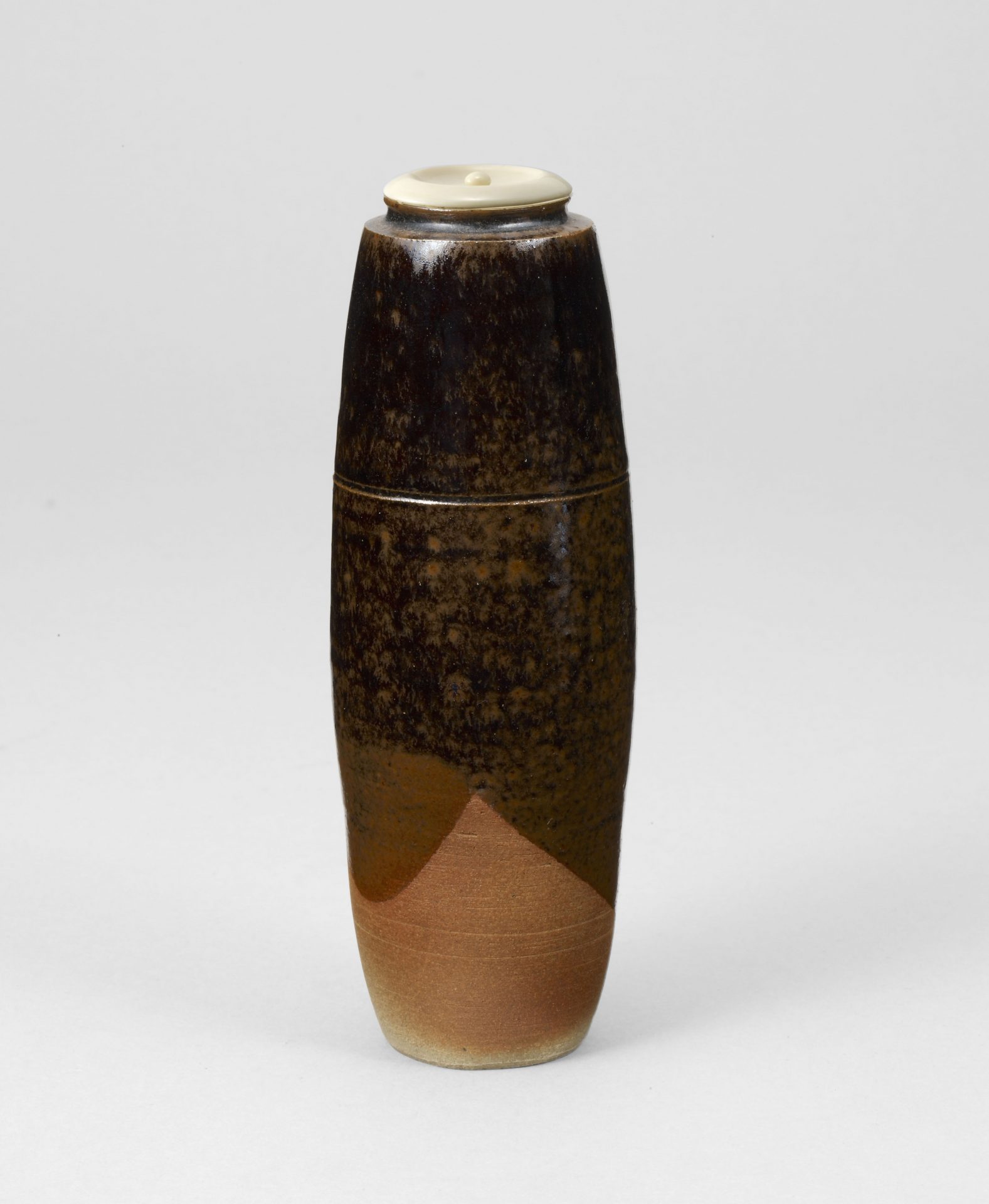
Shouldered oblong tea caddy with Seto glaze “Zon-mei”
NOMURA ART MUSEUM
This very tall tea caddy, one of several known specimens, was probably featured in the Sowa Kondate (course menus) with a description of “Omuro’s tall tea caddy.” The selection of the finest clay is evident, and the shoulders are rather sharply angled. Different grades of Seto glaze are applied in layers to a beautiful effect, enhanced by the unglazed bottom shaped with a peak like a mountain, fired to the perfect coloring. More than a half of the lower part is solid, making the tea caddy more stable than it looks. The bottom shows a clockwise wire-cut, with a small Ninsei branding.
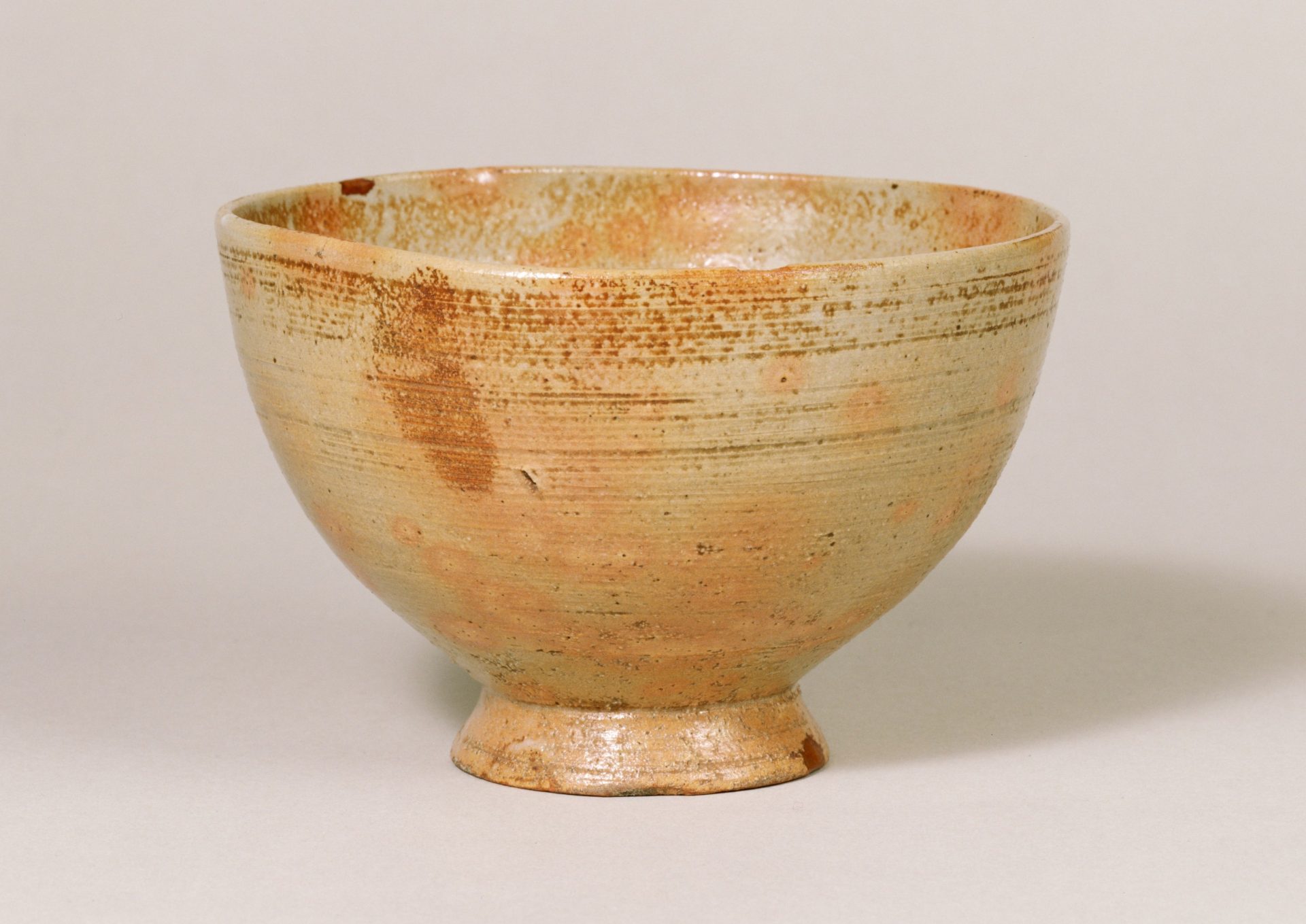 Seikado Bunko Art Museum Image Archive / DNPartcom
Tea bowl in Goki-style “Muichimon”
SEIKADO BUNKO ART MUSEUM
This is a reproduction of particular Korean earthenware known as Goki. Titled “Muichimon,” the bowl has a gentle curve from the rim to the bottom, and the base is tapered slightly. Reddish spots show both on the inside and outside. While details are reproduced faithfully to the cut-off patterns on the bottom of the base and the spiral inside the bottom concave, it is also marked by Ninsei’s originality in having a section on the side flattened. Ninsei’s branding is seen inside the base concave.
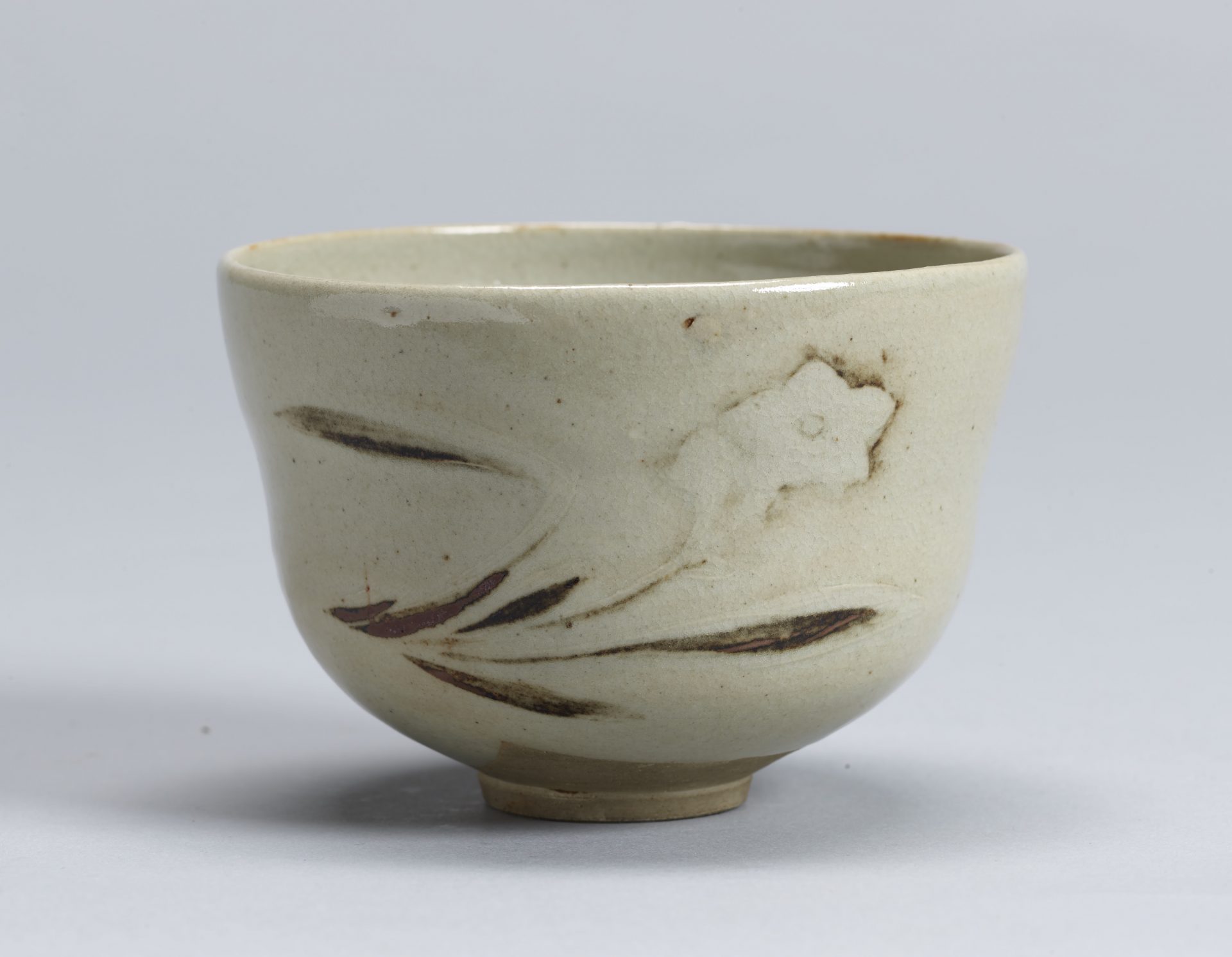
Tea bowl with sabi'e narcissus decoration
Important Cultural Property
Tennenji temple
The bowl that speaks of the relationship between Kanamori Sowa and Ninsei, discerned from a letter of donation that Sowa donated wrote, addressing his family parish temple Ten-neiji of Kyoto. The bowl has a shape typically of Sowa’s favorite, with a gentle squeeze in the middle of the body and rounded rim, leaning slightly inward. The daffodil is painted in rusty glaze against the white opaque glaze, but Ninsei also uses slip to give texture to the flowers, the stem and the leaves. The base is relatively small but sharply defined, bearing a small Ninsei branding inside.
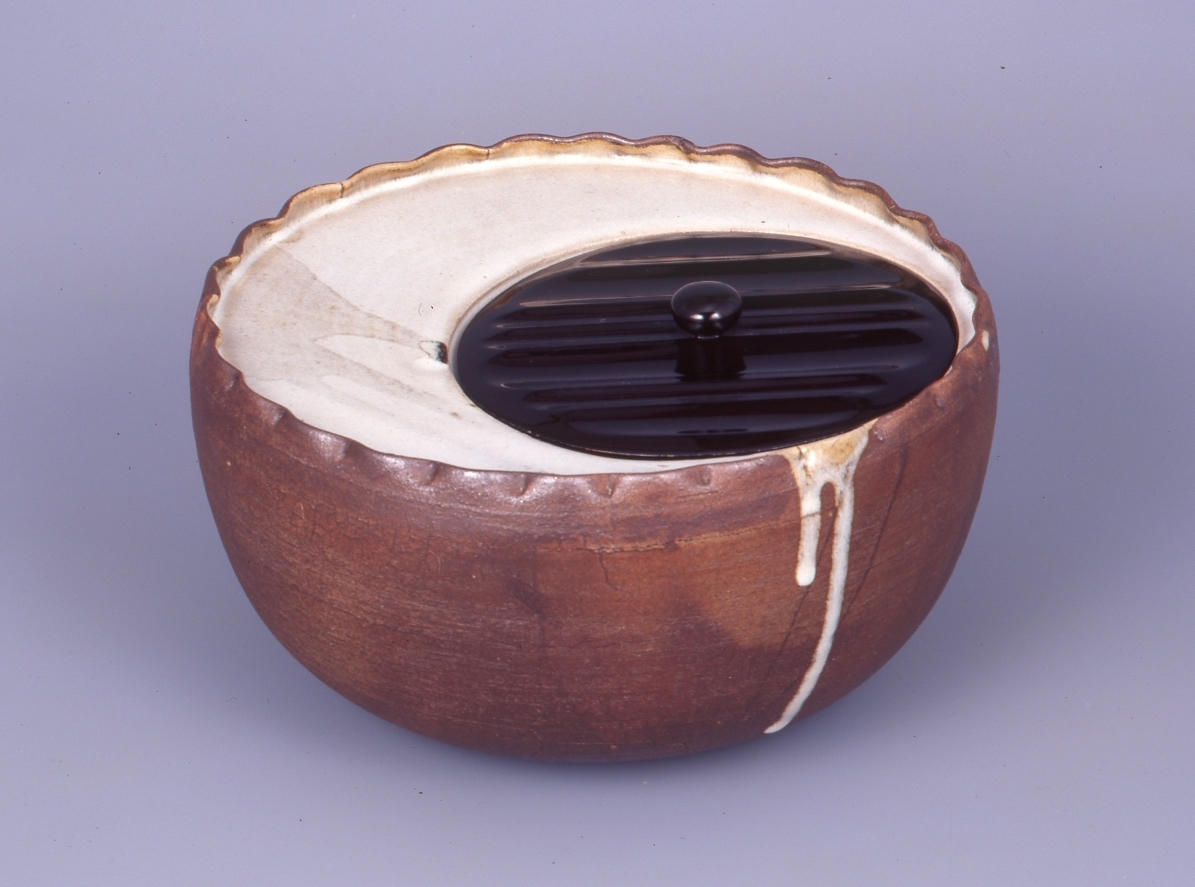
Water jar with frilled rim and white glaze “Snow, the Moon and flower”
YUKI MUSEUM OF ART
The water jar in the shape of an iron bowl has an enclosing top member and frilled protruding rim. The intriguing patterns are executed with rusty glaze on the top cover and the side, followed by white glaze covering the top and the inside, with two streaks of opaque glaze as if they treacle from the opening. The white, the round opening and the frilled rim represent snow, the moon and flower, respectively, and altogether symbolize the natural beauty throughout seasons. The bottom flat is marked with Ninsei branding.

Side plates in the shape of a lily flower
NEZU MUSEUM
A set of five little plates are delicately crafted into a lily flower shape by shaping strips of clay in a mold. The six petals are pleated in the middle, with each pointed end dipped in cobalt oxide for coloring. The bottom has a trace of glaze, indicating that the glaze on the bottom was wiped off before firing.